
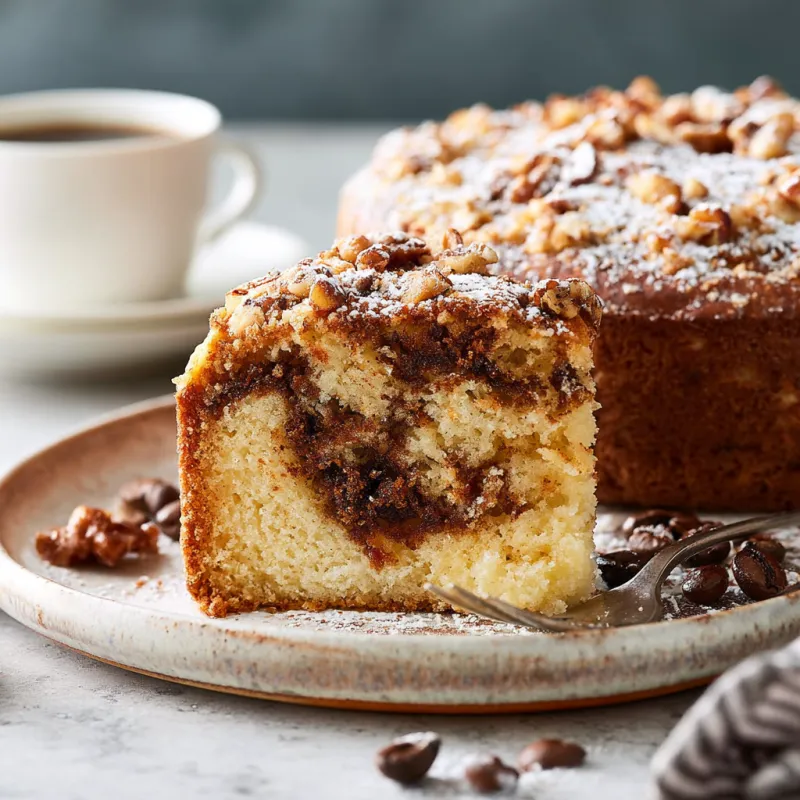
The first thing you notice is the crackled, golden streusel — cinnamon and walnuts toasted into a crunchy crown. Break through it with a fork, and the cake beneath gives way with a tender, almost velvety crumb. This is not a dry coffee cake. It’s moist, with a subtle tang that cuts through the sweetness, and it stays that way for days.

Greek yogurt is the key. It replaces some of the butter and milk, adding richness without heaviness. The acidity tenderizes the gluten, giving you a finer, more even crumb. And because Greek yogurt is thicker than sour cream, it holds the batter together beautifully, so the cake bakes up with a nice dome and a soft center.
The Ratio That Makes It Work
I keep the ratio at 1:1 yogurt to flour by weight — that’s 1 cup (about 240g) of Greek yogurt for every 1 1/2 cups (180g) of flour. This gives you enough moisture to keep the cake tender without making it heavy. The yogurt also lets me cut the butter to just 1/2 cup, so the cake isn’t greasy. The result is a coffee cake that feels substantial but not dense, with a clean, bright finish.
Streusel That Stays Crunchy
The streusel is a simple 1:1:1 ratio of flour, brown sugar, and cold butter by volume, with cinnamon and walnuts. The trick is to use cold butter and work it in until the mixture looks like coarse sand with a few pea-sized pieces. Those larger bits melt into crunchy clusters during baking. I always add the nuts — they toast in the oven and add texture that contrasts with the soft cake. If you skip them, the streusel will be more crumbly and less interesting.
Mixing Method: The Why
I use the creaming method — beating the butter and sugar together first to incorporate air. This gives the cake lift. The eggs go in one at a time, each beaten until fully combined, so the emulsion stays stable. Then I alternate the dry ingredients and the yogurt-milk mixture, starting and ending with flour. This prevents the batter from curdling and keeps the gluten development minimal. Overmixing at this stage will make the cake tough. Mix just until the last streak of flour disappears — about 10 seconds on low speed.
Layering for Even Baking
I spread half the batter in the pan, then sprinkle half the streusel. The second half of batter goes on top — it’s thick, so I drop spoonfuls and gently spread them with an offset spatula. Then the remaining streusel goes on. This double-layer method ensures every slice has streusel in the middle and on top. The middle layer also keeps the center from sinking as it bakes.
Doneness Cues
Bake at 350°F (175°C) for 30-35 minutes in a 9×9-inch metal or glass pan. The top should be deep golden brown, and the edges will start to pull away from the sides. Insert a toothpick into the center — it should come out clean or with a few moist crumbs attached. If it’s wet with batter, bake for 2-3 more minutes and check again. Let it cool in the pan for at least 20 minutes before slicing. Cutting too early will make the cake fall apart.
Common Mistake to Avoid
Using cold yogurt or eggs straight from the fridge. Cold ingredients won’t cream properly with the butter, and the batter can look curdled or separate. Let everything sit at room temperature for 30 minutes before you start. The yogurt should be stirred smooth, not lumpy.
Storage and Make-Ahead Tips
This cake actually tastes better the next day — the flavors settle and the crumb softens. Cover the pan tightly with plastic wrap and keep at room temperature for up to 3 days. For longer storage, refrigerate for up to 5 days. To freeze, wrap individual slices in plastic wrap and foil; thaw at room temperature for about 30 minutes. Reheat slices in a 300°F oven for 5 minutes to refresh the streusel.
Substitutions
For a dairy-free version, use plant-based butter, plain coconut yogurt, and oat milk. The texture will be slightly less tender but still good. For a nut-free streusel, replace walnuts with rolled oats or sunflower seeds. For a gluten-free version, use a 1:1 gluten-free baking blend that contains xanthan gum; handle the batter gently and do not overmix.
Takeaway: This Greek yogurt coffee cake is the one you’ll make for brunch, for a neighbor, or just for yourself on a quiet Sunday morning. It’s straightforward, forgiving, and genuinely better than most bakery versions — because you made it, and because the yogurt gives it that little something extra. Keep the ratio in mind, don’t overmix, and you’ll have a perfect slice every time.
Frequently Asked Questions
Can I use nonfat Greek yogurt?
Yes, but the cake will be slightly less tender. Full-fat or 2% Greek yogurt gives the best moisture and tang. If using nonfat, add 1 extra tablespoon of butter or oil to compensate.
Why did my coffee cake turn out dry?
Overbaking is the most common cause. Start checking at 30 minutes. The toothpick should come out with a few moist crumbs, not completely clean. Also, make sure your yogurt and eggs are at room temperature so the batter emulsifies properly.
Can I make this gluten-free?
Yes, substitute the all-purpose flour with a 1:1 gluten-free baking blend (one that contains xanthan gum). The texture will be slightly more delicate, so handle the batter gently and do not overmix.
How is this different from sour cream coffee cake?
Greek yogurt has a thicker consistency and a more pronounced tang than sour cream. It also adds a bit more protein. The cake stays just as moist, but the crumb is slightly firmer and less delicate. I prefer it for a breakfast cake that holds up well.
Greek Yogurt Coffee Cake
Ingredients
Equipment
Method
- Preheat the oven to 350°F (175°C). Grease a 9x9-inch baking pan or line with parchment paper.
- Make the streusel: In a small bowl, whisk together flour, brown sugar, and cinnamon. Cut in cold butter using a pastry blender or your fingertips until mixture resembles coarse crumbs. Stir in walnuts. Set aside.
- Make the cake: In a medium bowl, whisk together flour, baking powder, baking soda, and salt.
- In a large bowl, beat softened butter and granulated sugar with an electric mixer on medium speed until light and fluffy, about 2 minutes. Scrape down the bowl.
- Add eggs one at a time, beating well after each addition. Mix in vanilla.
- In a small bowl or measuring cup, stir together Greek yogurt and milk until smooth.
- With the mixer on low speed, add the flour mixture in three additions, alternating with the yogurt mixture in two additions, beginning and ending with flour. Mix just until combined — do not overmix. The batter will be thick.
- Spread half the batter into the prepared pan. Sprinkle with half the streusel. Spread the remaining batter on top (it helps to drop spoonfuls and gently spread). Sprinkle the remaining streusel evenly over the top.
- Bake for 30-35 minutes, until a toothpick inserted in the center comes out clean or with a few moist crumbs. The top should be golden brown and the edges just pulling away from the pan.
- Cool in the pan on a wire rack for at least 20 minutes before slicing. Serve warm or at room temperature.