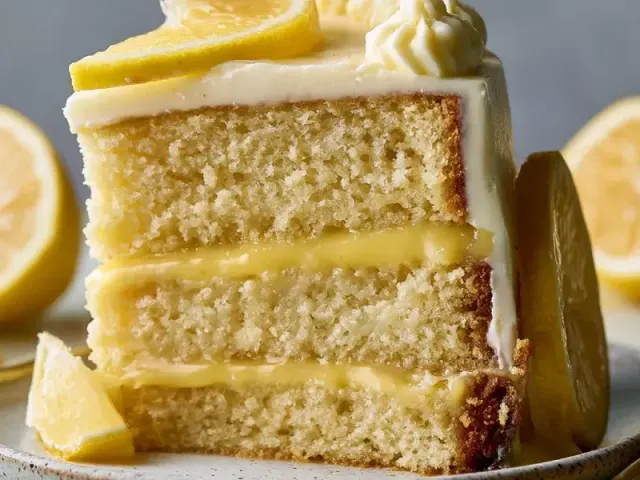
Bright Lemon Layer Cake with Silky Lemon Buttercream
The first thing you notice with this lemon layer cake is the scent. It hits you before you even take a bite — bright, sharp, and floral all at once. The crumb is tender but sturdy enough to hold a generous layer of homemade lemon curd without sinking. And the buttercream? It's silky, not too sweet, and carries just enough lemon to make you pucker slightly.

I've baked a lot of lemon cakes over the years, and the biggest problem I see is dry, crumbly layers that taste more like lemon-scented cardboard than anything celebratory. The fix is a technique called reverse-creaming. Instead of creaming butter and sugar together first, you rub the butter into the dry ingredients until it looks like damp sand. This coats the flour in fat, which limits gluten formation and produces a fine, even crumb that stays moist for days.
Why This Lemon Layer Cake Works
The reverse-creaming method is the backbone here. It's not new — it's how many classic bakery cakes are made — but it makes a real difference in home kitchens where ovens can be finicky. The batter comes together in under 10 minutes, and the layers bake flat and even. No doming, no cracking, just a level surface that's ready for stacking.
I also use a combination of lemon zest and juice in both the cake and the buttercream. The zest provides the floral, aromatic notes, while the juice gives the sharp tang. In the cake, I add the zest and juice to the wet ingredients, which distributes the flavor evenly without drying out the batter.
The lemon curd is non-negotiable. Yes, you can buy it, but homemade curd takes 10 minutes on the stove and tastes infinitely brighter. My ratio is 1 part lemon juice to 1 part sugar by volume, with 3 egg yolks per ½ cup of juice. This gives a curd that's thick enough to spread but still soft and glossy.
Key Ingredients and Ratios
Cake Flour (300g)
Cake flour has a lower protein content than all-purpose, which means less gluten and a softer crumb. If you swap in all-purpose, the cake will still taste good, but it will be slightly denser. See the FAQ for a quick substitute.
Butter at Cool Room Temperature (65°F/18°C)
This is critical for reverse-creaming. If the butter is too warm, it won't rub into the flour properly; if it's too cold, it won't incorporate. Press your finger into the butter — it should give slightly but still feel firm. Cool, not soft.
Fresh Lemon Juice and Zest
Bottled lemon juice has a flat, metallic taste. Use fresh lemons for both the juice and zest. One large lemon yields about 3 tablespoons of juice and 1 tablespoon of zest. For this recipe, you'll need about 6 lemons total.
Step-by-Step Method
Make the lemon curd first. It needs time to chill and set. Combine lemon juice, zest, sugar, and egg yolks in a small saucepan. Cook over medium-low heat, stirring constantly with a heatproof spatula. The curd is ready when it reaches 170°F (77°C) on an instant-read thermometer and thickly coats the spatula. Stir in the butter until smooth, then strain through a fine-mesh sieve. Press plastic wrap directly onto the surface to prevent a skin from forming, and refrigerate.
Prepare the pans and preheat the oven. Grease three 8-inch round pans, line the bottoms with parchment, and dust with flour. This ensures the layers release cleanly.
Reverse-cream the dry ingredients and butter. In the bowl of a stand mixer with the paddle attachment, combine the cake flour, sugar, baking powder, and salt. Mix on low for 30 seconds. Add the butter pieces one at a time, mixing until the mixture looks like damp sand with no visible butter lumps. This takes about 2 minutes.
Add the wet ingredients. Whisk the eggs, milk, lemon zest, lemon juice, and vanilla together in a separate bowl. With the mixer on low, add the wet mixture in three additions, scraping down the bowl after each. Mix just until smooth — about 30 seconds total. Overmixing at this stage will toughen the cake.
Bake. Divide the batter evenly among the prepared pans (about 380g per pan). Bake at 350°F (175°C) for 22-25 minutes. The cakes are done when a toothpick inserted in the center comes out clean or with a few moist crumbs, and the edges start to pull away from the pans. Cool in the pans for 10 minutes, then turn out onto a wire rack to cool completely.
Make the lemon buttercream. Beat the room-temperature butter on medium-high for 3 minutes until pale and creamy. Gradually add the sifted powdered sugar, then the lemon juice, zest, heavy cream, and salt. Beat for another 2-3 minutes until light and fluffy. If the frosting seems too soft, refrigerate for 10 minutes before using.
Assemble the cake. Place one layer on a serving plate. Spread half the chilled lemon curd over the top, leaving a ½-inch border. Repeat with the second layer and the remaining curd. Top with the third layer. Apply a thin crumb coat of buttercream all over the cake, then refrigerate for 15 minutes. Finish with the final coat of buttercream, smoothing the sides with an offset spatula and creating swirls on top if desired.
Slice and serve. For the cleanest slices, refrigerate the finished cake for at least 30 minutes. Use a sharp serrated knife and wipe it clean between cuts. Let slices sit at room temperature for 10 minutes before serving to soften the buttercream.
My One Non-Negotiable Tip
Let the cake layers cool completely before you even think about frosting them. If they're even slightly warm, the buttercream will melt and slide off. I wait at least 1 hour after they come out of the pans. If I'm in a hurry, I pop them in the freezer for 15 minutes.
This lemon layer cake is bright, balanced, and genuinely stays moist for days. The reverse-creaming method makes it forgiving for bakers at any level, and the homemade lemon curd adds a tangy punch that store-bought can't match. Whether it's for a birthday, a spring gathering, or just because you need something sunny on the table, this cake delivers.
Frequently Asked Questions
Can I use all-purpose flour instead of cake flour?
Yes, but the texture will be slightly denser. For a closer substitute, measure 2 cups all-purpose flour, remove 4 tablespoons, and replace with 4 tablespoons cornstarch. Sift together three times before using.
Why did my lemon curd turn out runny?
It likely didn't cook long enough. The curd needs to reach 170°F (77°C) to set properly. Stir constantly over medium-low heat until it visibly thickens and coats the back of a spoon. Also, make sure to strain it to remove any cooked egg bits.
Can I make this cake ahead of time?
Absolutely. Bake the cake layers up to 2 days ahead and wrap them tightly in plastic wrap once cool. The lemon curd can be made 3 days ahead. Assemble and frost the day you plan to serve for the freshest taste.
How do I get clean, even cake layers?
Use a kitchen scale to divide the batter evenly (about 380g per 8-inch pan). If your cakes dome slightly, use a serrated knife to level the tops before assembling. Chill the cake for 30 minutes before slicing with a sharp knife.
Bright Lemon Layer Cake with Silky Lemon Buttercream

A tender, moist lemon layer cake filled with tangy lemon curd and frosted with a silky lemon buttercream. The secret to its texture is a reverse-creaming method that keeps the crumb tight and even.
- three 8-inch round cake pans
- stand mixer or hand mixer
- rubber spatula
- cooling rack
- offset spatula
- piping bag (optional)
- serrated knife
- For the Cake:
- 2 ½ cups 300g cake flour
- 1 ½ cups 300g granulated sugar
- 1 tablespoon baking powder
- ½ teaspoon salt
- 1 cup 226g unsalted butter, at cool room temperature (65°F/18°C)
- 4 large eggs (at room temperature)
- 1 cup 240ml whole milk, at room temperature
- 2 tablespoons fresh lemon zest (from about 3 lemons)
- 2 tablespoons fresh lemon juice
- 1 teaspoon vanilla extract
- For the Lemon Curd:
- ½ cup 120ml fresh lemon juice (from about 3 lemons)
- 1 tablespoon fresh lemon zest
- ½ cup 100g granulated sugar
- 3 large egg yolks
- 4 tablespoons 56g unsalted butter, cut into small pieces
- For the Lemon Buttercream:
- 1 cup 226g unsalted butter, at room temperature
- 4 cups 480g powdered sugar, sifted
- 3 tablespoons fresh lemon juice
- 1 tablespoon fresh lemon zest
- 2 tablespoons heavy cream (or whole milk)
- Pinch of salt
- Make the lemon curd first. In a small saucepan, whisk together lemon juice, lemon zest, sugar, and egg yolks. Cook over medium-low heat, stirring constantly with a heatproof spatula, until it thickens enough to coat the back of a spoon (about 5-7 minutes, or 170°F/77°C on an instant-read thermometer). Remove from heat and stir in the butter pieces until smooth. Pour through a fine-mesh strainer into a bowl, cover with plastic wrap pressed directly onto the surface, and refrigerate until cold (at least 1 hour).
- Preheat your oven to 350°F (175°C). Grease three 8-inch round cake pans, line the bottoms with parchment rounds, and dust with flour.
- In the bowl of a stand mixer fitted with the paddle attachment, combine the cake flour, sugar, baking powder, and salt. Mix on low for 30 seconds to aerate.
- With the mixer on low, add the butter pieces one at a time, mixing until the mixture looks like damp sand with no large butter lumps (about 2 minutes). This is the reverse-creaming method — it coats the flour in fat and limits gluten development, giving you a tender, even crumb.
- In a separate bowl, whisk together the eggs, milk, lemon zest, lemon juice, and vanilla until combined.
- With the mixer on low, add the wet ingredients in three additions, scraping down the bowl after each. Mix just until the batter is smooth — about 30 seconds total. Do not overmix.
- Divide the batter evenly among the prepared pans (about 380g per pan). Bake for 22-25 minutes, until a toothpick inserted in the center comes out clean or with a few moist crumbs, and the edges pull away slightly from the pans.
- Cool the cakes in their pans on a wire rack for 10 minutes, then turn them out onto the rack to cool completely. Wait until they are fully room temperature before assembling.
- While the cakes cool, make the lemon buttercream. In the bowl of a stand mixer with the paddle attachment, beat the butter on medium-high until pale and creamy (about 3 minutes). Reduce speed to low and gradually add the powdered sugar, then add the lemon juice, zest, cream, and salt. Increase speed to medium-high and beat for 2-3 minutes until light and fluffy. If the frosting seems too soft, refrigerate for 10 minutes.
- To assemble, place one cake layer on a serving plate or cake stand. Spread half of the chilled lemon curd over the top, leaving a ½-inch border. Repeat with the second layer and remaining curd. Top with the third layer.
- Frost the entire cake with the lemon buttercream, starting with a thin crumb coat (a thin layer that seals in crumbs). Refrigerate for 15 minutes to set, then apply the final coat. Use an offset spatula for smooth sides, or create swirls on top with a piping bag.
- For clean slices, refrigerate the finished cake for at least 30 minutes before cutting. Use a sharp serrated knife, wiping it clean between cuts.
Storage: This cake keeps well in an airtight container at room temperature for 1 day, or in the refrigerator for up to 4 days. Bring refrigerated slices to room temperature for the best texture and flavor. Freeze unfrosted cake layers, wrapped tightly in plastic and foil, for up to 3 months. The lemon curd can be made 3 days ahead. Common allergens: this recipe contains dairy (butter, milk, cream), eggs, and gluten (cake flour). For a dairy-free version, substitute the butter with a high-fat vegan butter (like Earth Balance) and the milk/cream with full-fat oat milk. For a gluten-free version, use a high-quality 1:1 gluten-free flour blend and add ¼ teaspoon xanthan gum if not included. Always consult a qualified professional for specific dietary needs.
Recipe: Bright Lemon Layer Cake with Silky Lemon Buttercream
Equipment
- three 8-inch round cake pans
- stand mixer or hand mixer
- rubber spatula
- cooling rack
- offset spatula
- piping bag (optional)
- serrated knife
Ingredients
- For the Cake:
- 2 ½ cups 300g cake flour
- 1 ½ cups 300g granulated sugar
- 1 tablespoon baking powder
- ½ teaspoon salt
- 1 cup 226g unsalted butter, at cool room temperature (65°F/18°C)
- 4 large eggs (at room temperature)
- 1 cup 240ml whole milk, at room temperature
- 2 tablespoons fresh lemon zest (from about 3 lemons)
- 2 tablespoons fresh lemon juice
- 1 teaspoon vanilla extract
- For the Lemon Curd:
- ½ cup 120ml fresh lemon juice (from about 3 lemons)
- 1 tablespoon fresh lemon zest
- ½ cup 100g granulated sugar
- 3 large egg yolks
- 4 tablespoons 56g unsalted butter, cut into small pieces
- For the Lemon Buttercream:
- 1 cup 226g unsalted butter, at room temperature
- 4 cups 480g powdered sugar, sifted
- 3 tablespoons fresh lemon juice
- 1 tablespoon fresh lemon zest
- 2 tablespoons heavy cream (or whole milk)
- Pinch of salt
Instructions
- Make the lemon curd first. In a small saucepan, whisk together lemon juice, lemon zest, sugar, and egg yolks. Cook over medium-low heat, stirring constantly with a heatproof spatula, until it thickens enough to coat the back of a spoon (about 5-7 minutes, or 170°F/77°C on an instant-read thermometer). Remove from heat and stir in the butter pieces until smooth. Pour through a fine-mesh strainer into a bowl, cover with plastic wrap pressed directly onto the surface, and refrigerate until cold (at least 1 hour).
- Preheat your oven to 350°F (175°C). Grease three 8-inch round cake pans, line the bottoms with parchment rounds, and dust with flour.
- In the bowl of a stand mixer fitted with the paddle attachment, combine the cake flour, sugar, baking powder, and salt. Mix on low for 30 seconds to aerate.
- With the mixer on low, add the butter pieces one at a time, mixing until the mixture looks like damp sand with no large butter lumps (about 2 minutes). This is the reverse-creaming method — it coats the flour in fat and limits gluten development, giving you a tender, even crumb.
- In a separate bowl, whisk together the eggs, milk, lemon zest, lemon juice, and vanilla until combined.
- With the mixer on low, add the wet ingredients in three additions, scraping down the bowl after each. Mix just until the batter is smooth — about 30 seconds total. Do not overmix.
- Divide the batter evenly among the prepared pans (about 380g per pan). Bake for 22-25 minutes, until a toothpick inserted in the center comes out clean or with a few moist crumbs, and the edges pull away slightly from the pans.
- Cool the cakes in their pans on a wire rack for 10 minutes, then turn them out onto the rack to cool completely. Wait until they are fully room temperature before assembling.
- While the cakes cool, make the lemon buttercream. In the bowl of a stand mixer with the paddle attachment, beat the butter on medium-high until pale and creamy (about 3 minutes). Reduce speed to low and gradually add the powdered sugar, then add the lemon juice, zest, cream, and salt. Increase speed to medium-high and beat for 2-3 minutes until light and fluffy. If the frosting seems too soft, refrigerate for 10 minutes.
- To assemble, place one cake layer on a serving plate or cake stand. Spread half of the chilled lemon curd over the top, leaving a ½-inch border. Repeat with the second layer and remaining curd. Top with the third layer.
- Frost the entire cake with the lemon buttercream, starting with a thin crumb coat (a thin layer that seals in crumbs). Refrigerate for 15 minutes to set, then apply the final coat. Use an offset spatula for smooth sides, or create swirls on top with a piping bag.
- For clean slices, refrigerate the finished cake for at least 30 minutes before cutting. Use a sharp serrated knife, wiping it clean between cuts.